
Skip the printing. Keep the reference.
In the first article we made the case for retiring the motivational mockup as a communication step: it exists to help the patient picture a result, it costs close to €200 and four hours per case, and Smile Design does that same communication job in the first appointment — on screen, in front of the patient, at zero material cost.
But the motivational mockup isn't the only printed reference on the timeline. Further down there's a second one — the functional mockup — and its cost profile is nearly identical: 1–2 hours of lab time, ~€20 in resin, ~€200 a case, plus another half-day of clinical and lab time. Two mockups per case. Roughly half a day, two-plus appointments, and ~€400 in production before the patient's even in the chair.
Where Blueprint and Review come in.
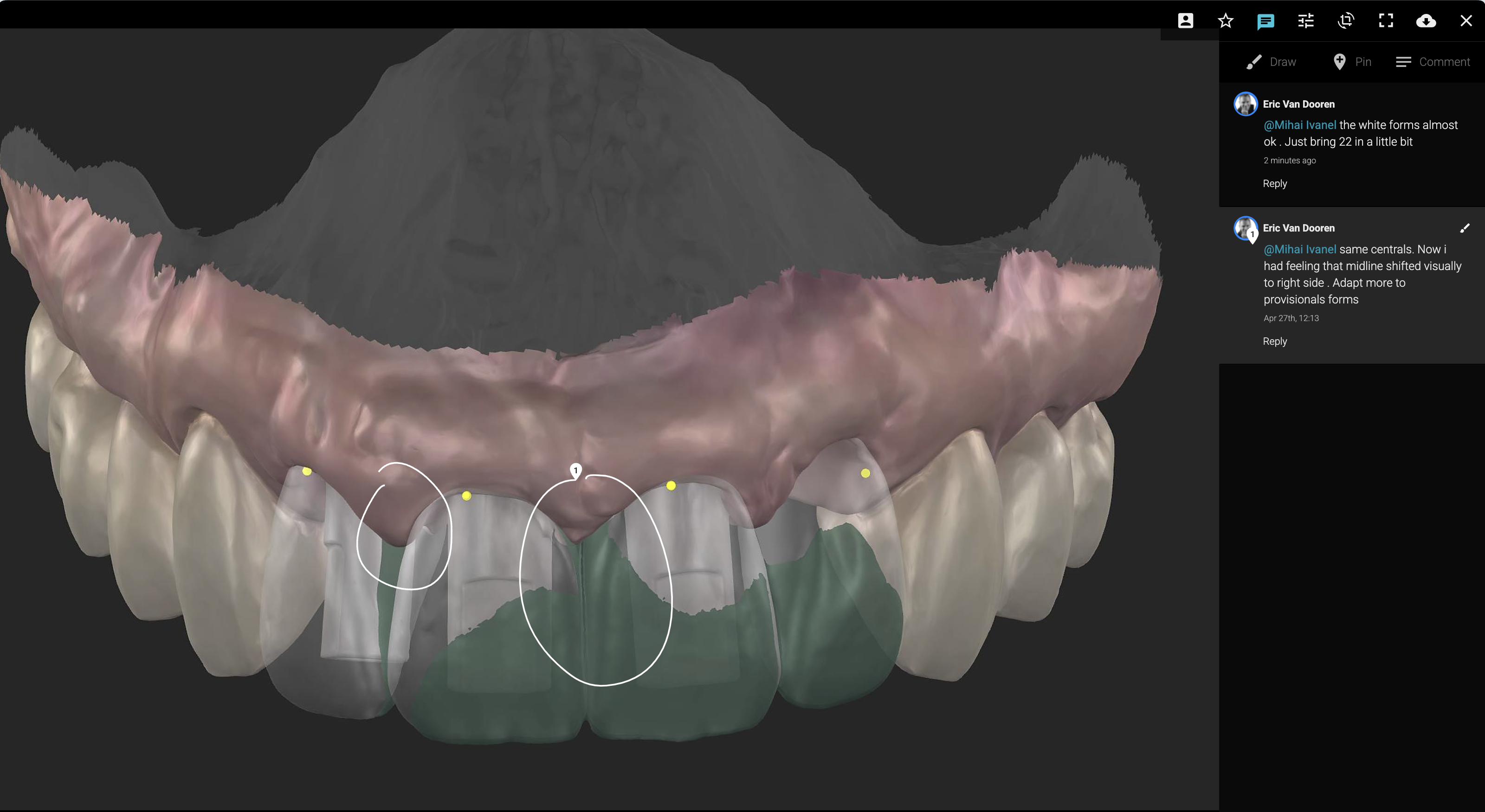
You've already built the Smile Design to get the yes. You convert it into a Blueprint and create the 3D design — and this time the technician is looking at it and agreeing with you in real time, on the same view, instead of days apart through a printed proxy.
Then, during prep, you scan the prepared teeth and load the scan into Review, overlaid on your Blueprint. Prep and design, together, in 3D, on one screen — for you, the technician and the patient to look at and talk through, live.
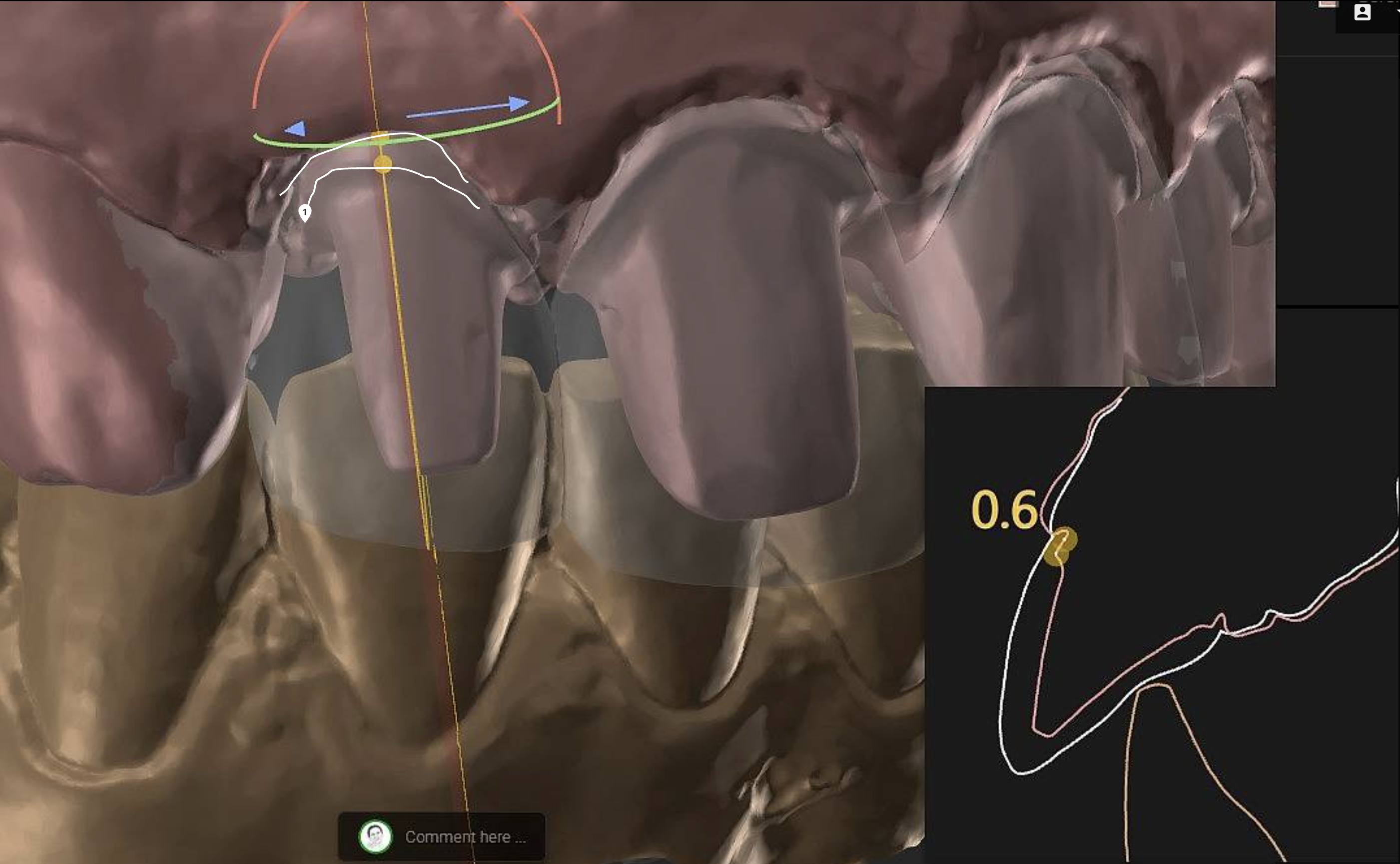
Not satisfied? Adjust, re-scan, look again, while the patient's still in the chair. Every scan and every iteration is saved with the case.
What the on-screen reference adds that a printed one can't:
- One shared 3D view instead of a static printed proxy.
- Iteration during the appointment, not at a recall.
- A digital record — every scan, every version, kept with the case.
- Zero material cost per look. Re-scanning is free; reprinting isn't.
Clinical judgment stays exactly where it's always been — with you. Blueprint and Review don't make the call; they put everyone in front of the same picture while you make it.
Set the right expectations.
This isn't overnight, and it isn't all-or-nothing. Adoption is a gradient: most clinicians try Smile Design on one case instead of the motivational mockup, like it, try another, and after a few start reaching for Blueprint on the cases that would normally get the full printed treatment.
Dentcof's own timeline shows the same shape — the printed-mockup use fell sharply from ~70% of cases (late 2024) to <15% (2026), as the team leaned on the on-screen reference.
A direction, not a decision.
Nothing to lose.
On the fully digital path, the numbers land around: ~€400 in lab and materials saved per case, several hours of clinical and lab time returned, an appointment cycle or two compressed out, and less rework chasing physical references. For a clinic running 100 restorative cases a year, that's roughly €40,000 in production cost avoided — plus the time freed for the next case.
The mockups were never the treatment. They were how you communicated the plan and kept everyone on the same page. Blueprint and Review do that job digitally — for the cost of a subscription that pays for itself in less than a filling. Try it at your own pace.
- How to create a Blueprint from a Smile Design → https://learn.smilecloud.com/en/article/create-a-blueprint
- How to stack scan data in Review → https://learn.smilecloud.com/en/article/align-3d-files
Smilecloud Blueprint is a Class I medical device for the visualisation and communication of dental imaging and design data. It does not provide diagnosis, measurements, or treatment planning, and is not to be relied upon for clinical decisions.
Review is a separate Smilecloud module and is not part of the Smilecloud Blueprint medical device.